16 Sept 2026 · Case #011
Thrombotic thrombocytopenic purpura (TTP)
This page works the case through in full, answer included. If you would rather reason it out yourself: Play this case
Diagnosis
Thrombotic thrombocytopenic purpura (TTP)
First-line treatment
Urgent plasma exchange (plus corticosteroids)
How the diagnosis is reached
Schistocytes with a high LDH, low haptoglobin and a negative Coombs test establish that red cells are being destroyed mechanically rather than by antibody: they are being physically sheared, not marked for removal. Pair that with severe thrombocytopenia and the differential is short, and the discriminators are all present here. Normal PT, aPTT and fibrinogen argue against disseminated intravascular coagulation, where the clotting cascade is consumed wholesale. Renal impairment that is only mild, with neurological signs that fluctuate, argues for thrombotic thrombocytopenic purpura over haemolytic uraemic syndrome, in which renal failure dominates and a diarrhoeal illness usually precedes it. The mechanism explains every finding at once. ADAMTS13 normally cleaves ultra-large von Willebrand factor multimers as they are released; without it those multimers persist, platelets adhere to them spontaneously throughout the microcirculation, and the resulting thrombi both consume platelets and shred the red cells passing through. That is why treatment cannot wait for the confirmatory ADAMTS13 assay. Plasma exchange is started within hours of suspicion because it does two things at once, removing the autoantibody and replacing the missing enzyme, and because untreated mortality approaches 90 per cent against roughly 10 to 20 per cent with prompt exchange. High-dose corticosteroids are added, with caplacizumab and rituximab where available. Platelets are withheld unless bleeding is life-threatening, since transfusing them feeds the same microvascular thrombosis.
Key clinical clues
- Microangiopathic hemolysis: schistocytes, high LDH, low haptoglobin, negative Coombs test
- Severe thrombocytopenia with fluctuating, transient neurological symptoms
- Normal PT, aPTT and fibrinogen argue against DIC
- Only mild renal impairment, which argues against HUS, where renal failure dominates
- ADAMTS13 activity severely reduced (<10%), confirming TTP
The case in full
Presenting complaint
Patient history
A 38-year-old woman has three days of easy bruising, gum bleeding and worsening fatigue. Today her husband found her briefly confused about where she was, resolving within minutes. There has been no diarrhea, recent illness or new medication.
Physical examination
Physical examination
She is afebrile now but has had low-grade fevers at home. There are scattered petechiae over both lower legs, scleral icterus and mild abdominal tenderness, with no organomegaly. Neurology is normal apart from word-finding difficulty that comes and goes.
| Parameter | Value | Reference |
|---|---|---|
| Heart rate | 104 bpmRef 60–100 | 60–100 |
| Blood pressure | 128/78 mmHg | – |
| Temperature | 37.8 °CRef 36.1–37.5 | 36.1–37.5 |
Complete blood count
Laboratory results
A complete blood count is sent.
| Parameter | Value | Reference |
|---|---|---|
| Hemoglobin | 7.9 g/dLRef 12.0–15.5 | 12.0–15.5 |
| Platelets | 14 ×10⁹/LRef 150–400 | 150–400 |
| Reticulocyte count | 6.2 %Ref 0.5–2.5 | 0.5–2.5 |
| White blood cells | 8.4 ×10⁹/LRef 4.5–11.0 | 4.5–11.0 |
Hemolysis and coagulation studies
Laboratory results
Additional studies are sent to characterize the anemia and rule out a coagulopathy.
| Parameter | Value | Reference |
|---|---|---|
| LDH | 890 U/LRef 140–280 | 140–280 |
| Haptoglobin | <10 mg/dLRef 30–200 | 30–200 |
| Indirect bilirubin | 3.4 mg/dLRef 0.2–0.8 | 0.2–0.8 |
| Direct antiglobulin test (Coombs) | NegativeRef Negative | Negative |
| PT / aPTT | NormalRef PT 11–14 s, aPTT 25–35 s | PT 11–14 s, aPTT 25–35 s |
| Fibrinogen | NormalRef 200–400 mg/dL | 200–400 mg/dL |
Peripheral blood smear
Laboratory results
A peripheral blood smear is prepared and reviewed.
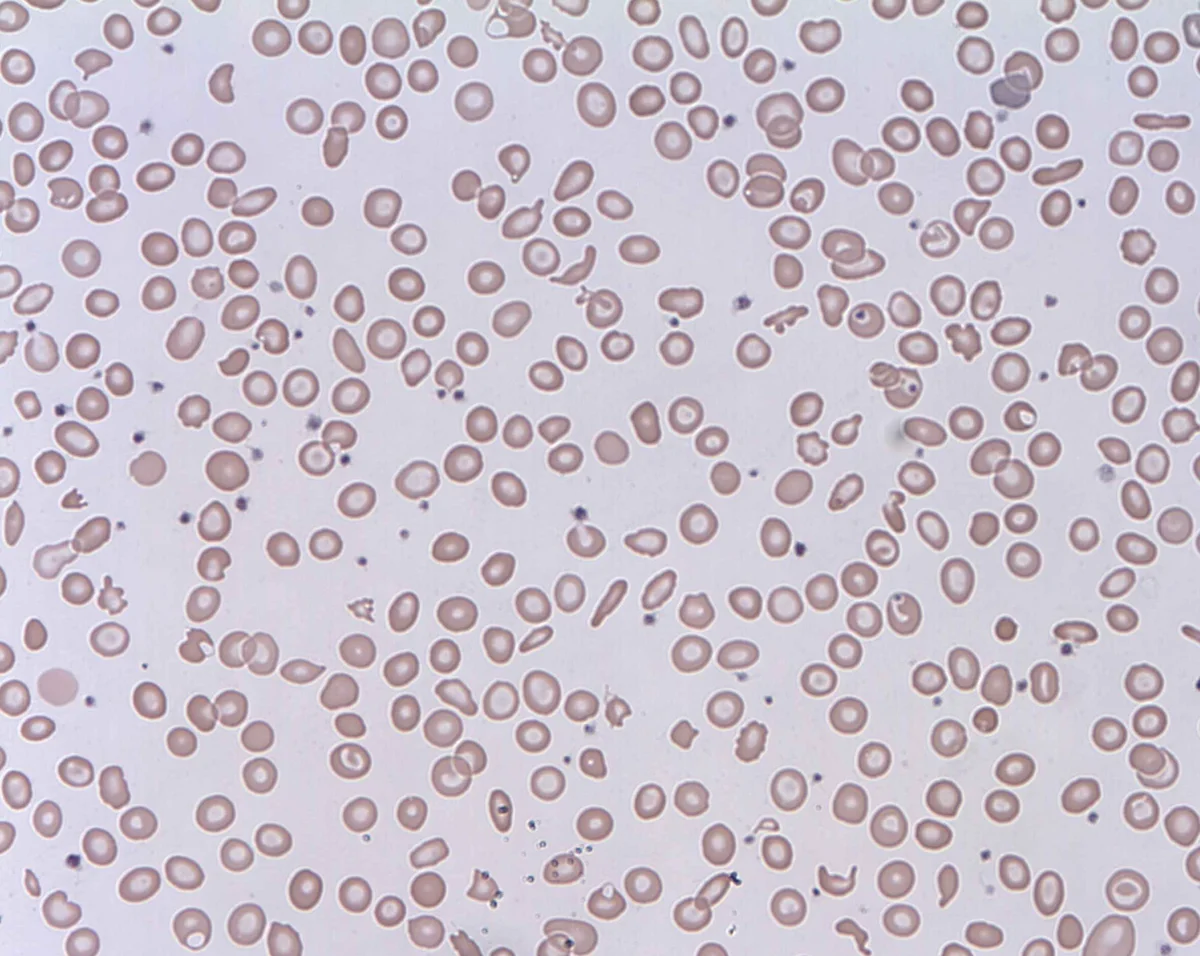
Peripheral smear, high power.
Image by Prof. Osaro Erhabor, via Wikimedia Commons. Licence: CC0.
Renal function and ADAMTS13 activity
Clinical course
Creatinine is only mildly raised, out of proportion to the severity of the hemolysis and thrombocytopenia. With a negative Coombs, normal coagulation and only mild renal involvement, urgent ADAMTS13 activity returns under 10% of normal.