18 Sept 2026 · Case #013
Legionella pneumonia (Legionnaires' disease)
This page works the case through in full, answer included. If you would rather reason it out yourself: Play this case
Diagnosis
Legionella pneumonia (Legionnaires' disease)
First-line treatment
Levofloxacin (or azithromycin)
How the diagnosis is reached
A pneumonia four days into amoxicillin and still deteriorating has largely excluded the organisms amoxicillin covers, and the sputum says the same thing more directly: abundant neutrophils, no visible organism. A plainly purulent pneumonia whose pathogen refuses to appear on the film is the signature of Legionella, which stains too faintly to be seen on a routine Gram preparation. Blood cultures sterile at 48 hours argue further against pneumococcus, which is frequently bacteraemic when disease runs this severe. Then comes the systemic reach that pneumococcal pneumonia lacks: confusion, headache and watery diarrhea out of proportion to the chest, a pulse of 82 at 39.6 °C, sodium of 124 mmol/L, raised transaminases, hypophosphatemia and a creatine kinase of 1240 U/L from rhabdomyolysis. The hyponatremia discriminates best, running both commoner and deeper here than in other community-acquired pneumonia. The hotel spa pool supplies the epidemiology, an aerosol-generating warm water system being how the organism reaches a lung at all. Treatment then follows from where the organism lives rather than what it is built from. Legionella is a Gram-negative bacillus and does have a cell wall; amoxicillin failed because the organism replicates inside alveolar macrophages, where the drug does not follow it. That calls for an agent which concentrates intracellularly: a respiratory fluoroquinolone such as levofloxacin, or a macrolide such as azithromycin, for 7 to 10 days and longer if he proves immunocompromised. A negative urinary antigen would have excluded nothing, since the test detects only serogroup 1, and the case is notifiable so the hotel's water system can be traced.
Key clinical clues
- Pneumonia failing to improve on amoxicillin, which cannot reach an intracellular organism
- Prominent confusion, headache and diarrhea out of proportion to the chest findings
- Relative bradycardia despite a temperature of 39.6 °C
- Hyponatremia with deranged transaminases and a raised creatine kinase
- Exposure to an aerosol-generating warm water system (hotel spa pool)
The case in full
Presenting complaint
Patient history
A 62-year-old smoker has five days of fever, headache and dry cough, plus three days of watery diarrhea. His wife says he grew confused yesterday and could not recall their address. They returned a week ago from a hotel where they used the spa pool daily.
Vital signs
Vital signs
He is febrile and tachypneic.
| Parameter | Value | Reference |
|---|---|---|
| Temperature | 39.6 °CRef 36.1–37.5 | 36.1–37.5 |
| Heart rate | 82 bpmRef 60–100 | 60–100 |
| Respiratory rate | 28 /minRef 12–20 | 12–20 |
| Blood pressure | 112/68 mmHg | – |
| SpO₂ (room air) | 88 %Ref 95–100 | 95–100 |
Chemistry panel
Laboratory results
Serum chemistry is sent as part of the sepsis workup.
| Parameter | Value | Reference |
|---|---|---|
| Sodium | 124 mmol/LRef 135–145 | 135–145 |
| Phosphate | 1.6 mg/dLRef 2.5–4.5 | 2.5–4.5 |
| ALT | 148 U/LRef 7–56 | 7–56 |
| AST | 132 U/LRef 10–40 | 10–40 |
| Creatine kinase | 1240 U/LRef 30–200 | 30–200 |
| Creatinine | 1.6 mg/dLRef 0.7–1.3 | 0.7–1.3 |
Inflammatory markers and blood count
Laboratory results
A full blood count and inflammatory markers are sent.
| Parameter | Value | Reference |
|---|---|---|
| White blood cells | 16.8 ×10⁹/LRef 4.5–11.0 | 4.5–11.0 |
| Lymphocytes | 0.6 ×10⁹/LRef 1.0–4.0 | 1.0–4.0 |
| C-reactive protein | 312 mg/LRef <5 | <5 |
| Procalcitonin | 4.8 ng/mLRef <0.5 | <0.5 |
| Platelets | 168 ×10⁹/LRef 150–400 | 150–400 |
Chest radiograph and treatment response
Imaging
A chest radiograph is taken. His family doctor started amoxicillin four days ago; despite this his oxygen requirement has continued to climb.
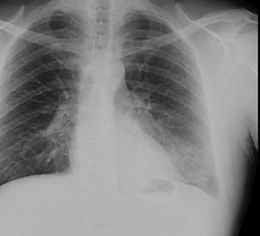
Frontal chest radiograph.
Image by Grottola et al., Emerging Infectious Diseases, via Wikimedia Commons. Licence: Public domain.
Microbiology
Laboratory results
Blood cultures are negative at 48 hours and sputum Gram stain shows abundant neutrophils but no organisms. A urinary antigen test is sent, and it returns positive.