20 Oct 2026 · Case #045
Lead poisoning
This page works the case through in full, answer included. If you would rather reason it out yourself: Play this case
Diagnosis
Lead poisoning
First-line treatment
Chelation therapy with succimer (DMSA)
How the diagnosis is reached
A microcytic anaemia with a normal ferritin and a normal transferrin saturation is where this case turns, because it removes iron deficiency, which is what a small red cell means almost every other time. What is left is a fault in haem synthesis rather than a shortage of iron, and lead inhibits two enzymes on that pathway: delta-aminolevulinic acid dehydratase near the start and ferrochelatase at the end. The raised bilirubin and the reticulocytosis say the cells that do get made are being destroyed early as well. The film agrees with the mechanism without proving it: coarse basophilic stippling is aggregated ribosomal RNA in cells whose haem assembly has stalled, and thalassaemia trait and myelodysplasia produce it too, so it narrows rather than settles. What makes this lead rather than porphyria is the pair of urine results. Acute intermittent porphyria produces this presentation almost exactly, colicky abdominal pain with a motor neuropathy and a change in personality, and it raises porphobilinogen. Here porphobilinogen is negative while aminolevulinic acid is markedly raised, which is the blocked enzyme immediately downstream rather than porphyria. Two examination findings point the same way and porphyria explains neither: a bilateral wrist drop from a radial-predominant motor axonal neuropathy, and a blue-grey gum line of deposited lead sulphide. Four months of burning and dry-sanding pre-1960 paint in closed rooms without a respirator supplies the inhaled dose, and eating with unwashed hands supplies the swallowed one. A venous blood lead concentration confirms the diagnosis and grades it. Treatment begins by ending the exposure, which is not a formality: chelating a man who goes back to sanding on Monday only mobilises more. He is clearly symptomatic but not encephalopathic, so the agent is oral succimer, a dimercaptosuccinic acid chelator that binds lead for renal excretion with less zinc depletion than sodium calcium edetate. Edetate with dimercaprol is held back for encephalopathy or a very high concentration. Concentrations rebound as bone stores re-equilibrate, so the level is repeated afterwards, and his workmates and household need testing too.
Key clinical clues
- Seven weeks of colicky central abdominal pain with constipation and irritability
- Four months burning and dry-sanding pre-1960 paint indoors with no respirator
- Bilateral wrist drop and a blue-grey line along the gum margin
- Microcytic anaemia with a normal ferritin and a raised reticulocyte count
- Coarse stippling on the film, with urinary ALA markedly raised and porphobilinogen negative
The case in full
Presenting complaint
Patient history
A 41-year-old man has had bouts of crampy pain across the middle of his abdomen for seven weeks. Each bout builds over an hour or two and then passes, leaving nothing behind. He is constipated, off his food, and describes a metallic taste that never quite goes. His wife says he has become short-tempered and forgetful.
Occupational history
Patient history
He restores sash windows in houses built before 1960 and has spent four months stripping old paint with a heat gun and dry sandpaper, mostly in closed rooms, wearing no respirator. He eats his lunch and rolls cigarettes in the same room without washing his hands first.
Examination and observations
Physical examination
He is pale. Both wrists drop when he holds his arms out in front of him, and finger extension is weak against resistance while grip strength is normal. A faint blue-grey line runs along the gum margin above the upper incisors. The abdomen is soft with no guarding and normal bowel sounds.
| Parameter | Value | Reference |
|---|---|---|
| Temperature | 36.6 °CRef 36.1–37.5 | 36.1–37.5 |
| Heart rate | 78 bpmRef 60–100 | 60–100 |
| Blood pressure | 144/90 mmHgRef <140/90 | <140/90 |
| Respiratory rate | 14 /minRef 12–20 | 12–20 |
Blood tests
Laboratory results
A blood count and a metabolic panel are sent.
| Parameter | Value | Reference |
|---|---|---|
| Haemoglobin | 96 g/LRef 130–170 | 130–170 |
| Mean cell volume | 74 fLRef 80–100 | 80–100 |
| Reticulocytes | 104 ×10⁹/LRef 20–80 | 20–80 |
| Ferritin | 142 µg/LRef 30–300 | 30–300 |
| Transferrin saturation | 31 %Ref 20–45 | 20–45 |
| Bilirubin | 29 µmol/LRef <21 | <21 |
| Creatinine | 121 µmol/LRef 60–110 | 60–110 |
| Urate | 0.52 mmol/LRef 0.20–0.42 | 0.20–0.42 |
Ruling out the mimics
Laboratory results
The other causes of recurrent abdominal pain with a motor neuropathy are screened for.
| Parameter | Value | Reference |
|---|---|---|
| Urine porphobilinogen | NegativeRef Negative | Negative |
| Urine delta-aminolevulinic acid | Markedly raisedRef Normal | Normal |
| Amylase | 64 U/LRef 30–110 | 30–110 |
| Coeliac serology | NegativeRef Negative | Negative |
| Abdominal ultrasound | NormalRef Normal | Normal |
| Nerve conduction studies | Motor axonal neuropathy, radial nerves worstRef Normal | Normal |
Blood film
Pathology
A film is made from the same sample as the blood count and reviewed by a haematologist. It is shown below. Many red cells are small and pale, and a proportion of them carry numerous coarse dark granules scattered evenly through the cytoplasm.
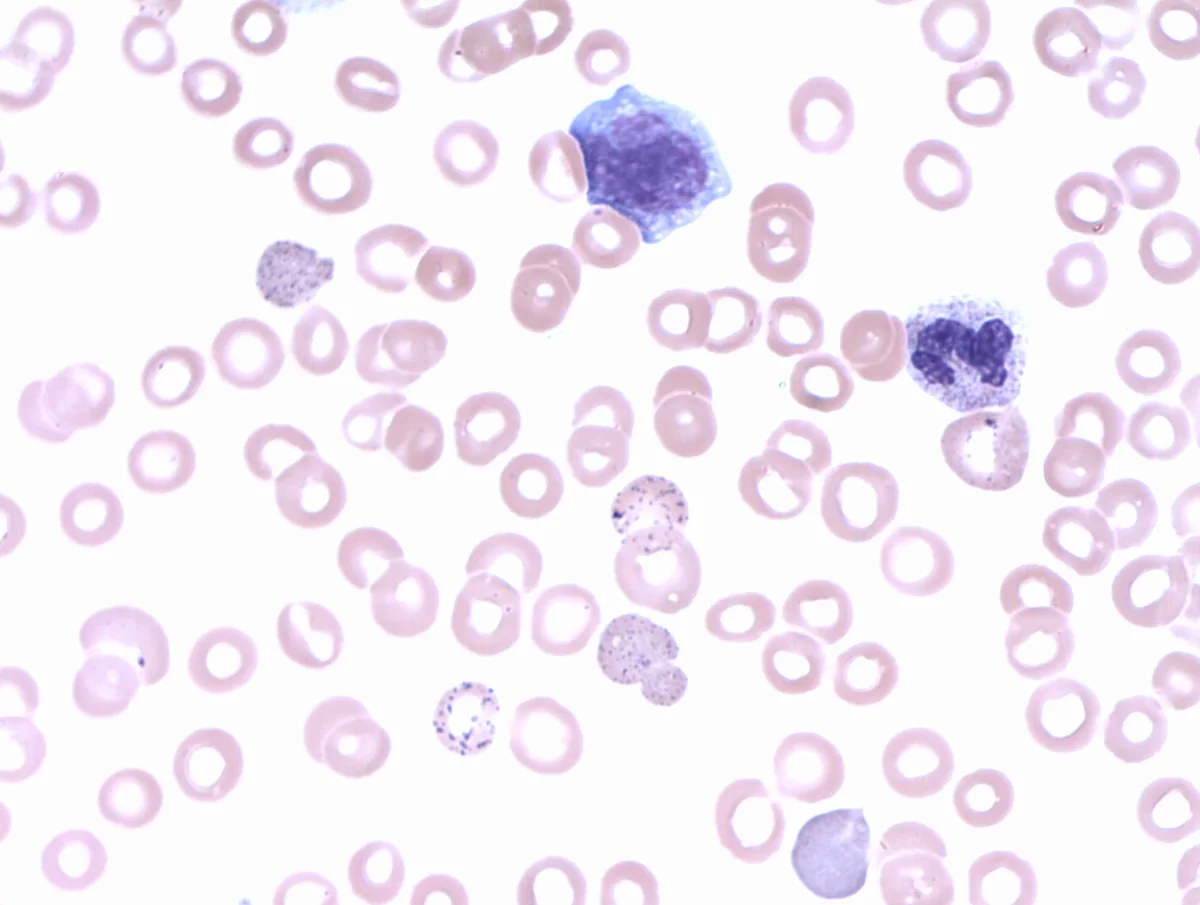
Peripheral blood film.
Image by Erhabor Osaro, via Wikimedia Commons, cropped to remove a burnt-in scale bar. Licence: CC BY-SA 4.0.