24 Oct 2026 · Case #049
Amatoxin (death cap) mushroom poisoning
This page works the case through in full, answer included. If you would rather reason it out yourself: Play this case
Diagnosis
Amatoxin (death cap) mushroom poisoning
First-line treatment
IV silibinin with N-acetylcysteine
How the diagnosis is reached
The clock diagnoses this before anyone identifies the mushroom. Vomiting that starts within an hour or two of the meal belongs to the species that make you wretched and then let you go, the muscarinic and gastrointestinal irritant syndromes, miserable and rarely fatal. A gap of six to twelve hours before the gut turns is the pattern that kills, because it means an amatoxin was absorbed and inside the hepatocytes long before the first symptom. The second half of the pattern is the false dawn: the diarrhoea stops, a day passes in which the patient believes she is recovering, and the liver then fails on the third. She is on the third day, jaundiced, encephalopathic and hypoglycaemic, with an ALT of 4820 and an INR of 3.4. Amatoxin blocks RNA polymerase II, so transcription stops and the cells that turn protein over fastest die first, hepatocytes and then renal tubules, which is why her creatinine is rising alongside. The specimen confirms what the timeline already said: white gills that stop short of the stem, a ring high on it and a sac at the base are a deadly Amanita, and a pale olive cap makes it phalloides. That the heaviest eater is the sickest is simply dose. The screen exists to remove the other ways a liver fails this fast, and one result matters more than the rest: paracetamol is not detected, which is worth knowing precisely because that is the poisoning with a nomogram and an antidote, and this is not it. Treatment is intravenous silibinin, which blocks the transporter carrying amatoxin into the hepatocyte and interrupts its recycling through the bile, with N-acetylcysteine alongside, since that improves survival in non-paracetamol liver failure as well. Activated charcoal still earns its place late, because the toxin keeps returning through the enterohepatic circulation. Neither drug is an antidote in the ordinary sense. The decision that actually saves her is about transplantation, so she is discussed with a transplant centre today against King's criteria, with the INR and the encephalopathy repeated every few hours rather than daily.
Key clinical clues
- Vomiting that began ten hours after a foraged meal, not within the hour
- Eighteen hours of gastroenteritis, then a whole day of feeling better
- Jaundice, a flap and confusion on day three, with a glucose of 3.1
- ALT of 4820 with an INR of 3.4 and a creatinine that is climbing
- White free gills, a ring high on the stem, and a sac at its base
The case in full
Presenting complaint
Patient history
A 46-year-old woman arrives on the third day of an illness. It opened with violent vomiting and watery diarrhoea that began late one evening, ran for about eighteen hours and then stopped. Yesterday she felt well enough to think it was over. This morning she is nauseated again, sore under the ribs on the right, and her husband says she keeps losing the thread of what she is saying.
History from the family
Patient history
The family picked mushrooms in beech woods four days ago and cooked them in a risotto that evening. She ate most of the dish; her husband and son had small helpings and each had one night of loose stools. Nobody drinks heavily, she takes no regular medication, and the son kept one uncooked specimen in the fridge and has brought it in.
Examination and observations
Physical examination
She is jaundiced. The outstretched hands flap. She is drowsy but rouses, knows where she is and cannot say the date. There is tenderness below the right costal margin without guarding, and the liver edge is not enlarged. She is dry, with slack skin and a dry tongue. There is no fever and no rash.
| Parameter | Value | Reference |
|---|---|---|
| Temperature | 36.4 °CRef 36.1–37.5 | 36.1–37.5 |
| Heart rate | 106 bpmRef 60–100 | 60–100 |
| Blood pressure | 102/62 mmHg | – |
| Glasgow Coma Scale | 14Ref 15 | 15 |
| Respiratory rate | 18 /minRef 12–20 | 12–20 |
Blood tests
Laboratory results
Bloods are taken on arrival and repeated four hours later.
| Parameter | Value | Reference |
|---|---|---|
| ALT | 4820 U/LRef <35 | <35 |
| AST | 3960 U/LRef <40 | <40 |
| Bilirubin | 96 µmol/LRef <21 | <21 |
| INR | 3.4Ref 0.8–1.2 | 0.8–1.2 |
| Glucose | 3.1 mmol/LRef 3.9–7.8 | 3.9–7.8 |
| Ammonia | 96 µmol/LRef <50 | <50 |
| Creatinine | 168 µmol/LRef 45–90 | 45–90 |
| Lactate | 4.2 mmol/LRef <2.0 | <2.0 |
Ruling out the mimics
Laboratory results
The other causes of a liver failing this fast are screened for.
| Parameter | Value | Reference |
|---|---|---|
| Paracetamol level | Not detectedRef Not detected | Not detected |
| Salicylate level | Not detectedRef Not detected | Not detected |
| Hepatitis A, B and C screen | All negativeRef Negative | Negative |
| Autoimmune liver screen | NegativeRef Negative | Negative |
| Blood alcohol | Not detectedRef Not detected | Not detected |
| Liver ultrasound with Doppler | Normal size and texture, hepatic veins patentRef Normal | Normal |
The specimen brought from home
Clinical course
The son's uncooked specimen is photographed and shown to the regional mycologist over video. It is pictured below, beside a second one he found at the same spot. The cap is pale olive and silky, the gills are white and stop short of the stem, a membranous ring sits high on the stem, and the base emerges from a loose sac. There is no red on the cap, and cutting it produces no colour change.
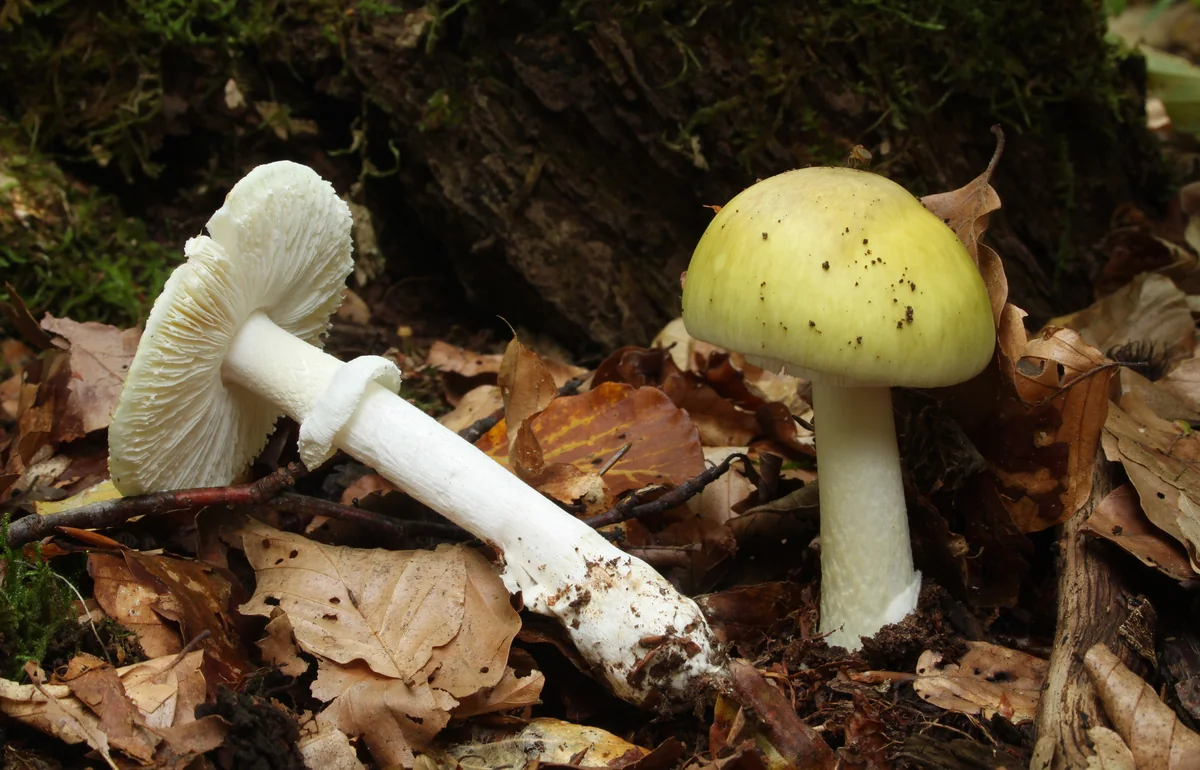
Specimen brought in by the family.
Image by Holger Krisp, via Wikimedia Commons. Licence: CC BY 3.0.