1 Oct 2026 · Case #026
Wernicke encephalopathy
This page works the case through in full, answer included. If you would rather reason it out yourself: Play this case
Diagnosis
Wernicke encephalopathy
First-line treatment
Immediate high-dose intravenous thiamine
How the diagnosis is reached
The triad of confusion, ocular abnormalities and ataxia in a malnourished heavy drinker is Wernicke encephalopathy, though all three features are present together in only about a third of cases, relying on the complete triad is the commonest reason it is missed. Bilateral lateral rectus palsies with nystagmus, a broad-based ataxic gait and global inattention with preserved consciousness are the pattern here. A normal ammonia and preserved consciousness argue against hepatic encephalopathy, and an undetectable ethanol level excludes simple intoxication. The critical error is visible in the fifth clue: dextrose was given before thiamine. Thiamine is an essential cofactor for pyruvate dehydrogenase and transketolase, and a glucose load in a deplete patient exhausts the remaining stores and precipitates deterioration: glucose must always follow thiamine, never precede it. Hypomagnesemia compounds this, since magnesium is required for thiamine-dependent enzymes to function, and encephalopathy will not resolve until it is corrected. The MRI changes are highly specific but insensitive; normal imaging never excludes the diagnosis, which is clinical. That is the whole argument for treating now: high-dose intravenous thiamine, at doses far above oral supplementation and before any further glucose-containing fluid, with magnesium replaced alongside it or the enzymes it feeds will not run. Thiamine is cheap and close to harmless, while untreated disease carries roughly 20% mortality and leaves a large proportion of survivors with irreversible Korsakoff amnesia. Set against that, waiting for imaging or for the full triad is not caution but a decision to accept the worse outcome.
Key clinical clues
- Confusion, ophthalmoplegia with nystagmus, and broad-based ataxia in a malnourished drinker
- Alert and inattentive rather than drowsy, with a normal ammonia: not hepatic encephalopathy
- Deterioration immediately after dextrose was given without thiamine cover
- Hypomagnesemia, a required cofactor, so encephalopathy persists until corrected
- Symmetrical mammillary body, medial thalamic and periaqueductal MRI signal change
The case in full
Presenting complaint
Patient history
A 52-year-old man is brought in by his landlord, who found him confused and unable to say what day it was. He drinks approximately a litre of vodka daily and has eaten little for several weeks.
Neurological examination
Physical examination
He is inattentive and disoriented in time and place but not drowsy. There is horizontal nystagmus on lateral gaze and impaired abduction of both eyes. He cannot stand without support, and his gait is broad-based and unsteady. Power and reflexes are preserved.
Observations and initial tests
Vital signs
Observations and a capillary glucose are recorded.
| Parameter | Value | Reference |
|---|---|---|
| Capillary glucose | 68 mg/dLRef 70–110 | 70–110 |
| Temperature | 36.1 °CRef 36.1–37.5 | 36.1–37.5 |
| Heart rate | 104 bpmRef 60–100 | 60–100 |
| Blood pressure | 108/66 mmHg | – |
| Glasgow Coma Scale | 14Ref 15 | 15 |
Laboratory results
Laboratory results
Bloods are sent.
| Parameter | Value | Reference |
|---|---|---|
| Magnesium | 1.2 mg/dLRef 1.7–2.4 | 1.7–2.4 |
| Mean cell volume | 104 fLRef 80–100 | 80–100 |
| Gamma-GT | 384 U/LRef 8–61 | 8–61 |
| Ethanol level | UndetectableRef Undetectable | Undetectable |
| Ammonia | 42 µmol/LRef 11–51 | 11–51 |
| Sodium | 138 mmol/LRef 135–145 | 135–145 |
Course in the department
Clinical course
He is given 5% dextrose for the low glucose reading. Over the following two hours his confusion deepens noticeably and he becomes unable to name his landlord.
Neuroimaging
Imaging
CT of the head is unremarkable. An axial FLAIR sequence from the subsequent MRI is shown below.
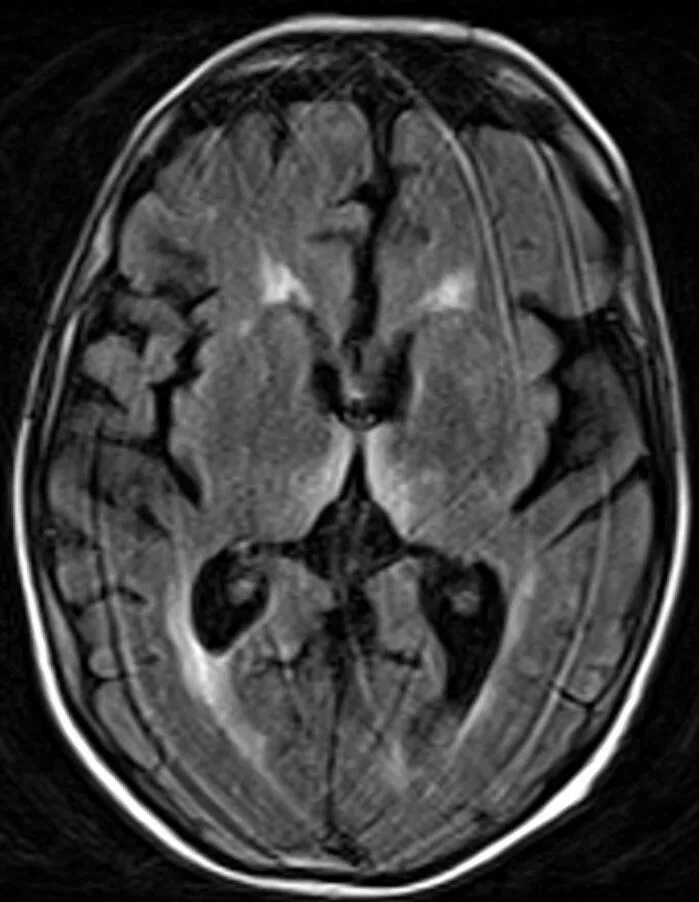
Axial FLAIR MRI.
Image by Jto410, via Wikimedia Commons. Licence: CC BY-SA 3.0.