17 Oct 2026 · Case #042
Malaria
This page works the case through in full, answer included. If you would rather reason it out yourself: Play this case
Diagnosis
Malaria
First-line treatment
IV artesunate
How the diagnosis is reached
Fever in someone back from sub-Saharan Africa is malaria until three blood films say otherwise, and nothing else in the history is allowed to distract from that until it is excluded. Prophylaxis abandoned after a week and no bed net removes the only two things that might have protected her. The blood count then points hard in one direction: thrombocytopenia is among the most consistent findings in malaria, and a low platelet count with fever and recent travel is close to a rule of thumb. The anaemia, raised bilirubin and raised LDH are haemolysis, red cells rupturing as parasites complete their cycle, and the palpable spleen is the organ clearing the debris. The rest of the panel exists to remove the conditions that look identical: a negative dengue antigen, sterile cultures, negative typhoid serology and a clean chest film and urine. The film is diagnostic, and it also grades severity, which is what decides the route of treatment. Falciparum shows fine ring forms and readily infects a red cell more than once, and a parasitaemia of 8% is far above the 2% that defines severe disease. She has three more severity markers besides: hypoglycaemia, a lactate above 2, and a creatinine that is climbing. That combination is what makes this intravenous artesunate rather than tablets. Artesunate clears parasites faster than quinine and carries a clear mortality advantage over it, so quinine survives only as a fallback where artesunate is unavailable. It runs until she can reliably swallow, after which a full oral artemisinin-combination course finishes the job, since artesunate alone does not eliminate the infection. Glucose is rechecked repeatedly, because the disease and quinine both cause hypoglycaemia and hers is already 3.4 mmol/L. She also needs warning about delayed post-artesunate haemolysis, which appears one to three weeks later and needs a follow-up blood count.
Key clinical clues
- Cyclical fever in a traveller returning from sub-Saharan Africa
- Prophylaxis stopped after one week, with no bed net used
- Thrombocytopenia alongside haemolytic anaemia, jaundice and splenomegaly
- Negative dengue, typhoid and cultures, removing the closest mimics
- Ring forms with multiply-infected cells and a parasitaemia of 8%, well into severe disease
The case in full
Presenting complaint
Patient history
A 31-year-old woman has had four days of high fever with shaking chills, headache and aching limbs. The fever spikes and then settles rather than staying up, and she feels wrung out between episodes.
Travel history
Patient history
She returned ten days ago from three weeks in rural Nigeria visiting family. She took antimalarial tablets for the first week but stopped when they upset her stomach, and she slept without a net.
Examination and observations
Physical examination
She looks unwell and mildly jaundiced. The spleen is palpable two finger-breadths below the costal margin. There is no rash, no neck stiffness and nothing focal in the chest or abdomen.
| Parameter | Value | Reference |
|---|---|---|
| Temperature | 39.4 °CRef 36.1–37.5 | 36.1–37.5 |
| Heart rate | 118 bpmRef 60–100 | 60–100 |
| Blood pressure | 104/64 mmHg | – |
| Respiratory rate | 24 /minRef 12–20 | 12–20 |
| Glasgow Coma Scale | 15Ref 15 | 15 |
Blood tests
Laboratory results
Bloods are sent on arrival.
| Parameter | Value | Reference |
|---|---|---|
| Haemoglobin | 96 g/LRef 115–165 | 115–165 |
| Platelets | 48 ×10⁹/LRef 150–400 | 150–400 |
| White cell count | 6.2 ×10⁹/LRef 4.0–11.0 | 4.0–11.0 |
| Bilirubin | 58 µmol/LRef <21 | <21 |
| LDH | 480 U/LRef <250 | <250 |
| Creatinine | 118 µmol/LRef 45–90 | 45–90 |
| Glucose | 3.4 mmol/LRef 3.9–7.8 | 3.9–7.8 |
| Lactate | 3.8 mmol/LRef <2.0 | <2.0 |
Ruling out the mimics
Laboratory results
The other causes of fever in a returning traveller are screened for.
| Parameter | Value | Reference |
|---|---|---|
| Dengue NS1 antigen | NegativeRef Negative | Negative |
| Blood cultures | No growth at 48 hRef No growth | No growth |
| Typhoid serology | NegativeRef Negative | Negative |
| Urinalysis | NormalRef Normal | Normal |
| Chest radiograph | ClearRef Clear | Clear |
Blood film
Pathology
Thick and thin films are prepared and examined under oil immersion. The thin film is shown below. The parasitaemia is reported at 8% of red cells.
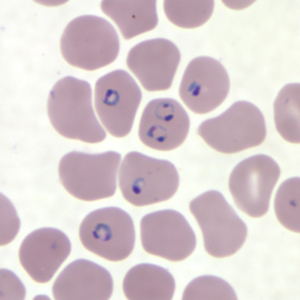
Thin blood film, Giemsa.
Image by CDC, from the DPDx parasitology image library, via Wikimedia Commons. Licence: Public domain.